ความท้าทายที่น่าจะต้องเผชิญ และวิธีรับมือ
Written 02:40, after the two prompt fixes. Point at a number and I will fix the tool, not this page.
1. What this session is, and how it differs from the morning
One tool, one server, two ladders. The 09:40 session is about a strength. This one is about a problem, and the five strengths are the toolkit they bring to it.
09:40 /reflect | The close /challenge | |
|---|---|---|
| Subject | ONE of their strengths | A problem they have right now |
| Strengths | Pick one, never say its name | All five, named, on screen |
| Tense | A past moment, recalled | Happening now, and what they will do |
| Output | A portrait, half blanked for a partner to spot | An action plan |
| Rungs | เหตุการณ์ · สิ่งที่ทำ · ผลที่เกิด · ผลเสีย | เรื่องที่เจอ · จุดที่ยาก · จุดแข็ง · แผนลงมือ |
The morning session hides the strength because a partner has to guess it. This is the applying session, so nothing is hidden. Nobody picks, nobody ranks.
2. The flow, as one manager lives it
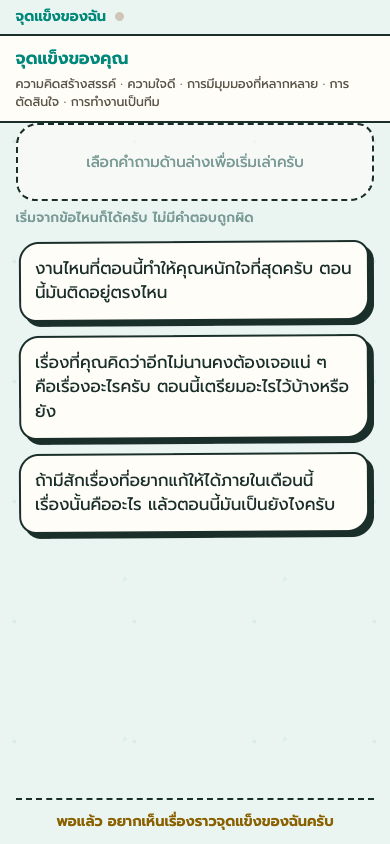
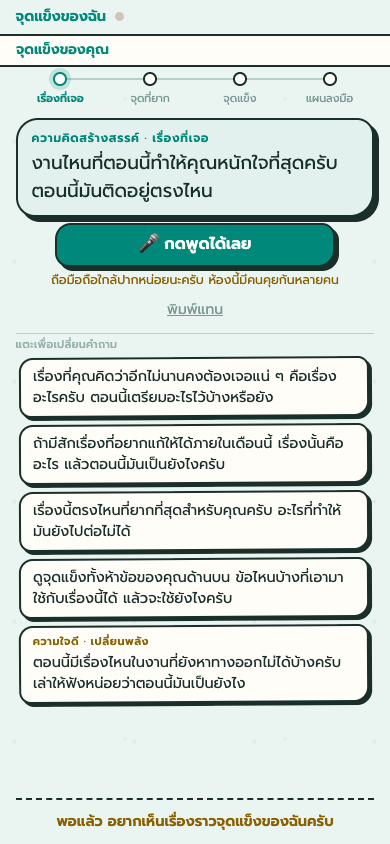
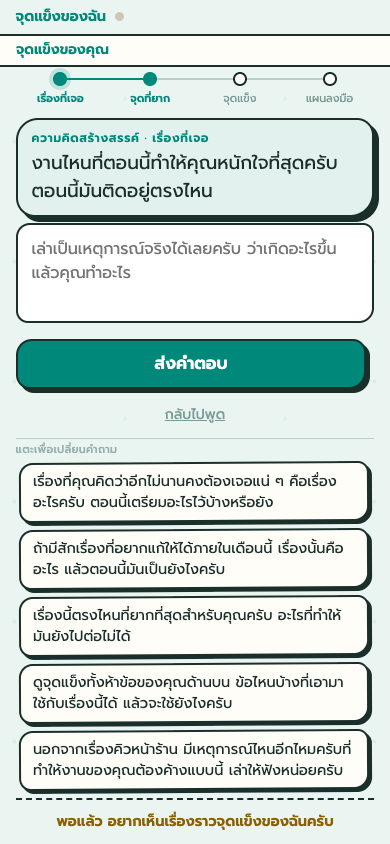
They arrive carrying their five
Same phone, same link shape as the morning. Their five VIA strengths are named at the top in Thai, all of them. Nothing is hidden this time.
Nobody hands them a question
The screen says เริ่มจากข้อไหนก็ได้ครับ ไม่มีคำตอบถูกผิด and offers three ways in. All three are about right now. None asks what they already tried.
Choosing the door is itself the first act of ownership, and it means thirty people are not all answering the same sentence at the same second.
They talk out loud, in a room with 29 other people talking
One tap on the mic. A line under it tells them to hold the phone close because the room is noisy. Typing is there for anyone who will not speak. Their words come back on screen as they say them, which is the moment most people realise it is really listening.
It follows them mid-sentence
From the run I drove tonight: the person said their branch has three new staff, the counter queue will not wait, and they end up covering it themselves every day. Before they finished, this was on the shelf:
Four dots track the shape, not the score
เรื่องที่เจอ · จุดที่ยาก · จุดแข็ง · แผนลงมือ. They fill as the material arrives, not as questions get answered. In the test run, one good answer filled two. Nobody is told "3 questions left", so it never becomes a task to finish.
They stay in charge of the order
Every other question sits below as a tappable card. They can jump to the plan early and come back. The tool never ends the session by itself, and it refuses to close while the session is still thin, so nobody walks away holding nothing.
Then it asks them to apply, not to admire
3. The OD frameworks, running underneath
Both frameworks steer the questions and neither is ever spoken to the participant. This is the whole design rule: the framework aims the tool, the participant just talks about their work.
Weisbord Six-Box: where the problem actually sits
A manager tells a problem from the one box they already live in, and believes that is the whole problem. "I cover the counter myself every day" gets told as an effort problem. It is a structure and mechanisms problem. Without a locator the tool digs deeper into the box that is already full. With one, it opens the box nobody has touched, and the plan that comes out holds.
| จุดมุ่งหมาย | Is the goal itself unclear, or not agreed |
| โครงสร้าง | How work is split, who owns what, everything landing on one person |
| ความสัมพันธ์ | How these specific people work together, conflict, who dares speak up |
| รางวัลและการยอมรับ | What actually happens to someone who does it well or badly here |
| กลไกช่วยงาน | Meetings, handovers, checklists, the follow-through that should carry the work |
| ภาวะผู้นำ | Who holds the balance, decides, sets direction, unblocks |
| สภาพแวดล้อมภายนอก | Outside and hard to change. Context, never the target |
Weisbord's own leverage insight is in the prompt too: the trouble usually sits in the gap between what is formally meant to happen and what actually happens. When the tool hears that mismatch, it aims there.
It also decides the plan. The move a person can make alone on a rewards problem is not the move on a mechanisms problem. Rung 3 aims at the box their own five strengths can actually reach.
Why Weisbord and not our own framework
Measured on our own corpus, 1,035 turns of real manager talk: Weisbord separates what managers say with an evenness of 0.938 against 0.788 for ORG-EEMM v0, whose biggest row absorbs 43.8% of everything said. Six-box already drives the org tool at the bare domain, so this costs nothing to keep and the research layer reads one vocabulary, not two.
Function over form: the loop that keeps the problem alive
A person stuck in a work problem is usually doing something that relieves it now and makes it worse later. The tool looks for four things and names none of them out loud:
| Antecedent | What sets it off, when and where it shows up |
| Coping | What they currently DO about it. Behaviour, not feeling |
| Short term | What that gets them immediately. The relief that keeps them doing it |
| Long term | What it costs them, which is usually why it is still a problem |
The branch manager serves customers himself when the queue is long. Short term the queue clears and he feels useful. Long term he never trains his juniors, so they stay slow, so the queue stays long, so he serves customers himself. Nothing in that chain is a character flaw. It is a loop that pays off immediately, and the plan only has to break one link.
4. What I fixed tonight
fixedThe prompt was reversing your most important correction, and had been for a day.
The head of the challenge prompt says ALL FIVE, NOT ONE. Do NOT ask them to choose a single strength, and do not rank them. The tail, which is the last thing the model reads and opens with "OVERRIDE, and it beats anything above it", said the whole job is to pick one.
That override was written to kill the morning ladder's never-name-the-strength rule and carried pick-one along with it. So the prompt said all five, then said the opposite and claimed priority. Naming kept, pick-one deleted, and rung 2 rewritten to two or three of the five working together.
Found by reading the assembled prompt. No test in this repo reads a prompt, which is why every suite stayed green while it was live. There is a harness for it now.
addedWeisbord six-box, as a silent locator.
In the prompt, not in a graph, so it costs zero extra model calls. Explicit instruction that a box
name reaching a participant-facing question is a rewrite, because your individual-not-organizational
correction stands: this maps one person's situation, it is not an org diagnosis. Two more keys on the
read we already capture, box and box_gap, logged and never shown.
5. Still broken, and whose
livePeteThe five vanish exactly when they are needed.
The moment they start answering, the strength names collapse off the screen. Then rung 3 says ดูจุดแข็งทั้งห้าข้อของคุณด้านบน and points at nothing. We built the applying session and hid the toolkit during the applying.
livePeteThe session labels their problem with one strength.
Every question wears a single strength name above it. In the morning that is the design. Here a person opens their hardest problem and the screen tags it ความคิดสร้างสรรค์.
liveAsked in the present, answered in the past.
Every rung was rewritten to present tense. The box they type into still says เล่าว่าเกิดอะไรขึ้น แล้วคุณทำอะไร. Whoever types instead of speaking gets the old session.
liveIt interrupts every 27 seconds.
Measured on your own 5-minute run: 11 questions in 302s. The corpus best asked one every 60 to 90. This is the biggest thing standing between a person and actually thinking, and it is untouched.
livePeteThey end a planning session and are handed a guessing game.
The close still produces the morning keepsake: a story about them with half of it blanked for a partner to spot. That game finished two hours earlier. Someone who just made a plan should leave holding the plan.
untestedNobody has completed a real voice session on this ladder.
Your one real voice run was on a stale cached page running the wrong ladder. Everything else is verified by typing, replay, or a driven browser, and none of those has ever been what found the real problems in this tool.
The one thing I still need from you
Does the paper action-plan worksheet still happen at 11:25 if the tool runs? Otherwise they do the same exercise twice, and the block also has to hold gratitude and the Lollipop Moment inside 20 minutes.
interview.leaddlab.com/challenge · both ladders on one process · /reflect untouched by any of tonight's work.